

The Creation-Redemption Mechanism Explained
How authorized participants keep ETF prices anchored to net asset value, and why the arbitrage they run benefits every ordinary investor.

The single most important design feature of the exchange-traded fund is a process that most investors never see. Every trading day, a small group of professional trading firms called authorized participants can create new ETF shares or redeem existing ones by transacting directly with the fund sponsor. This continuous exchange between shares and underlying securities is what keeps an ETF’s market price tethered to the value of the basket it holds. Without it, ETFs would trade like closed-end funds -- persistently at premiums or discounts. Because of it, they usually do not.
What an Authorized Participant Actually Does
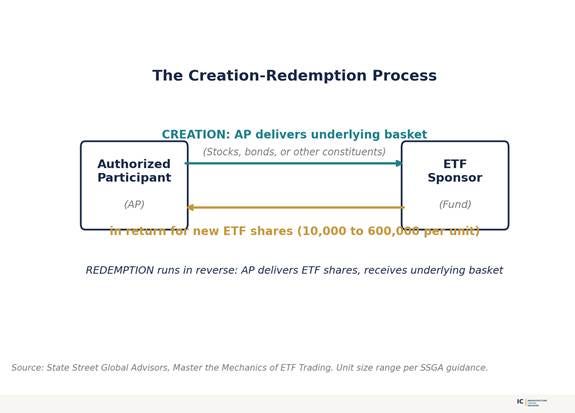
An authorized participant, or AP, is a US-registered, self-clearing broker-dealer that has signed a written agreement with the ETF sponsor giving it the right to transact in creation units. The number of APs varies by fund, but every US-listed ETF has at least one. In practice, the largest ETFs may have twenty or more.
On any given day, an AP can do two things. It can deliver a specified basket of underlying securities to the fund and receive newly issued ETF shares. Or it can deliver ETF shares to the fund and receive the underlying basket. Both transactions happen in large increments, called creation units, which typically range from 10,000 to 600,000 shares per unit. The AP pays a fixed fee per order, generally ranging from several hundred dollars to several thousand dollars depending on the fund and its asset class. That fee, plus any transaction costs the AP incurs in sourcing or offloading the underlying securities, becomes the floor for the bid-ask spread the AP is willing to quote in the secondary market.
Why APs Create and Redeem
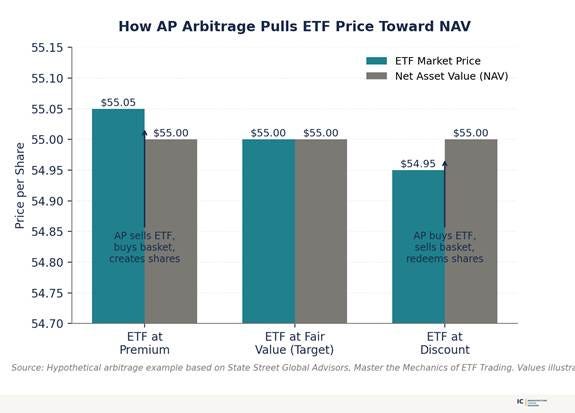
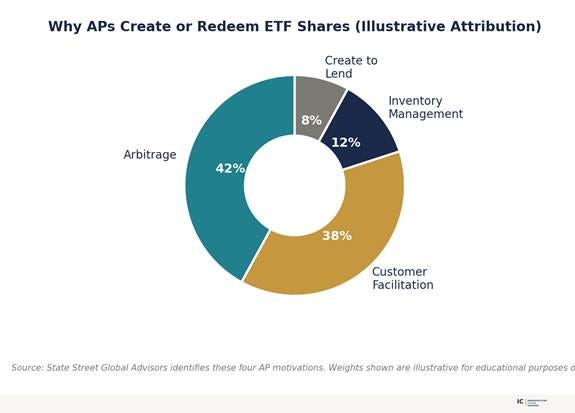
Authorized participants do not create or redeem ETF shares for philosophical reasons. They do it to make money, primarily through arbitrage and customer facilitation. When the ETF’s market price drifts above the value of the underlying basket, an AP can sell ETF shares in the secondary market and simultaneously buy the underlying securities. The AP then delivers those securities to the fund, receives new ETF shares, and uses them to flatten the short position. The AP has captured the spread between the ETF’s price and the underlying value, less its transaction costs.
The arbitrage runs in the opposite direction when the ETF trades at a discount. The AP buys ETF shares in the secondary market, delivers them to the fund for redemption, and receives the underlying basket to sell. In both cases, the AP earns the mispricing, and in both cases the ETF’s market price is pulled back toward the value of the fund’s holdings. Investors do not benefit from the trade directly, but they benefit from the discipline it enforces on the ETF’s price.
The second reason APs transact is customer facilitation. A large institutional buyer requesting $50 million of exposure to an ETF does not have to accept whatever is on the exchange screen. The buyer can ask an AP to quote a price against a same-day creation. The AP sources the underlying securities in the primary market for those names, delivers them to the fund, and delivers the resulting ETF shares to the client at a price close to net asset value. The client accessed liquidity that never appeared on the exchange book.
What This Means for Investors
The practical significance of the creation-redemption process shows up in three places. First, it keeps ETF prices near the fair value of the underlying basket under normal conditions. Persistent premiums or discounts of the kind that afflict closed-end funds are the exception, not the rule, in ETFs.
Second, it explains why ETFs holding liquid underlyings can absorb institutional orders without showing corresponding volume on the exchange screen. The primary market absorbs the order, and only the fund’s share count changes.
Third, it defines the outer boundary of when an ETF’s arbitrage mechanism may temporarily strain. During periods of extreme market stress, the underlying securities in a fund may become difficult or expensive to trade. When that happens, APs widen their quotes to account for the cost and risk of hedging their positions. Premiums and discounts to net asset value may open up more than usual. In fixed-income ETFs especially, the discount that appears during a stress event often reflects information the underlying bond market has not yet priced in. That discount is a signal, not a defect. The mechanism is doing what it was designed to do -- using investor demand to reveal the true clearing price of assets that are otherwise thinly traded.
Footnotes
1. State Street Global Advisors, Master the Mechanics of ETF Trading, describes the AP creation and redemption process and lists customer facilitation and arbitrage as the two most investor-relevant motivations for APs to transact.
2. Investment Company Institute, 2024 Investment Company Fact Book, reports that the largest US-listed ETFs typically have multiple authorized participants under contract.
3. Jane Street Capital, ETF Execution Strategies: A Guide for Institutional Traders, October 2019, explains how APs manage post-trade risk through primary-market redemption, hedging with correlated instruments, or holding the position.
4. Citigroup, ETFs and 40 Act Funds, July 2013, notes that the creation-redemption mechanism is a core feature of the Investment Company Act of 1940 framework as applied to ETFs.
About Us
Infrastructure Capital Advisors LLC is a SEC-registered investment adviser based in New York. The firm offers an ETF suite covering bond income, small-cap income, equity income, MLPs, preferred stock, and REIT preferreds. Funds: BNDS (Infrastructure Capital Bond Income ETF); SCAP (InfraCap Small Cap Income ETF); ICAP (InfraCap Equity Income Fund ETF); AMZA (InfraCap MLP ETF); PFFA (Virtus InfraCap U.S. Preferred Stock ETF); PFFR (InfraCap REIT Preferred ETF). For more information visit www.infracapfunds.com.
DISCLOSURE
This information is not an offer to sell, or solicitation of an offer to buy any investment product, security, or services offered by Jay Hatfield, or Infrastructure Capital Advisors, LLC, (”ICA”) or its affiliates. ICA, will only conduct such solicitation of an offer to buy any investment product or service offered by ICA, if at all, by (1) purported definitive documentation (which will include disclosures relating to investment objective, policies, risk factors, fees, tax implications and relevant qualifications), (2) to qualified participants, if applicable, and (3) only in those jurisdictions where permitted by law. Jay Hatfield or ICA may have a beneficial long or short position in securities discussed either through stock ownership, options, or other derivatives; nonetheless, under no circumstances does any article or interview represent a recommendation to buy or sell these securities. This discussion is intended to provide insight into stocks and the market for entertainment and information purposes only and is not a solicitation of any kind. ICA buys and sells securities on behalf of its fund investors and may do so, before and after any particular article herein is published, with respect to the securities discussed in any article posted. ICA’s appraisal of a company (price target) is only one factor that affects its decision whether to buy or sell shares in that company. Other factors might include, but are not limited to, the presence of mandatory limits on individual positions, decisions regarding portfolio exposures, and general market conditions and liquidity needs. As such, there may not always be consistency between the views expressed here and ICA’s trading or holdings on behalf of its fund investors. There may be conflicts between the content posted or discussed and the interests of ICA. Please reach out to the ICA for more information. Investors should make their own decisions regarding any investments mentioned, and their prospects based on such investors’ own review of publicly available information and should not rely on the information contained herein. ICA nor any of its affiliates accepts any liability whatsoever for any direct or consequential loss howsoever arising, directly or indirectly, from any use of the information contained herein. We have not sought, nor have we received, permission from any third-party to include their information in this article. Certain information contained in this document constitutes “forward-looking statements,” which can be identified by the use of forward-looking terminology such as “may,” “will,” “should,” “expect,” “anticipate,” “project,” “estimate,” “intend,” “continue” or “believe” or the negatives thereof or other variations thereon or other comparable terminology. Due to various risks and uncertainties, actual events or results may differ materially from those reflected or contemplated in such forward-looking statements.
This material must be preceded or accompanied by a prospectus. The information contained herein represents our subjective belief and opinions and should not be construed as investment, tax, legal, or financial advice. For a prospectus with this and other information about the Funds, please visit www.infracapfunds.com. Investors should consider the investment objectives, risks, charges, and expenses carefully before investing. Please read the prospectus carefully before investing. For more information about the Funds, Fund strategies or Infrastructure Capital, please reach out to Craig Starr at 212-763-8336 (Craig.Starr@icmllc.com). The Funds are distributed either by Quasar Distributors, LLC or by VP Distributors, LLC, an affiliate of Virtus ETF Advisers, LLC. ICAP, SCAP, and BNDS ETFs are distributed by Quasar Distributors LLC. PFFA, PFFR, and AMZA ETFs are distributed by VP Distributors, LLC an affiliated of Virtus ETF Advisers, LLC.