

U.S. small-cap stocks, long overshadowed by mega-cap technology leaders, have surged to record highs and recently outpaced the broader market. The move has surprised many investors who had grown accustomed to narrow leadership and persistent underperformance from smaller companies. The sudden resurgence raises an important question: does this rally mark the start of a more durable leadership shift, or is it another short-lived rotation driven by optimism rather than fundamentals?¹²
A Rally Driven by Growth and Rotation
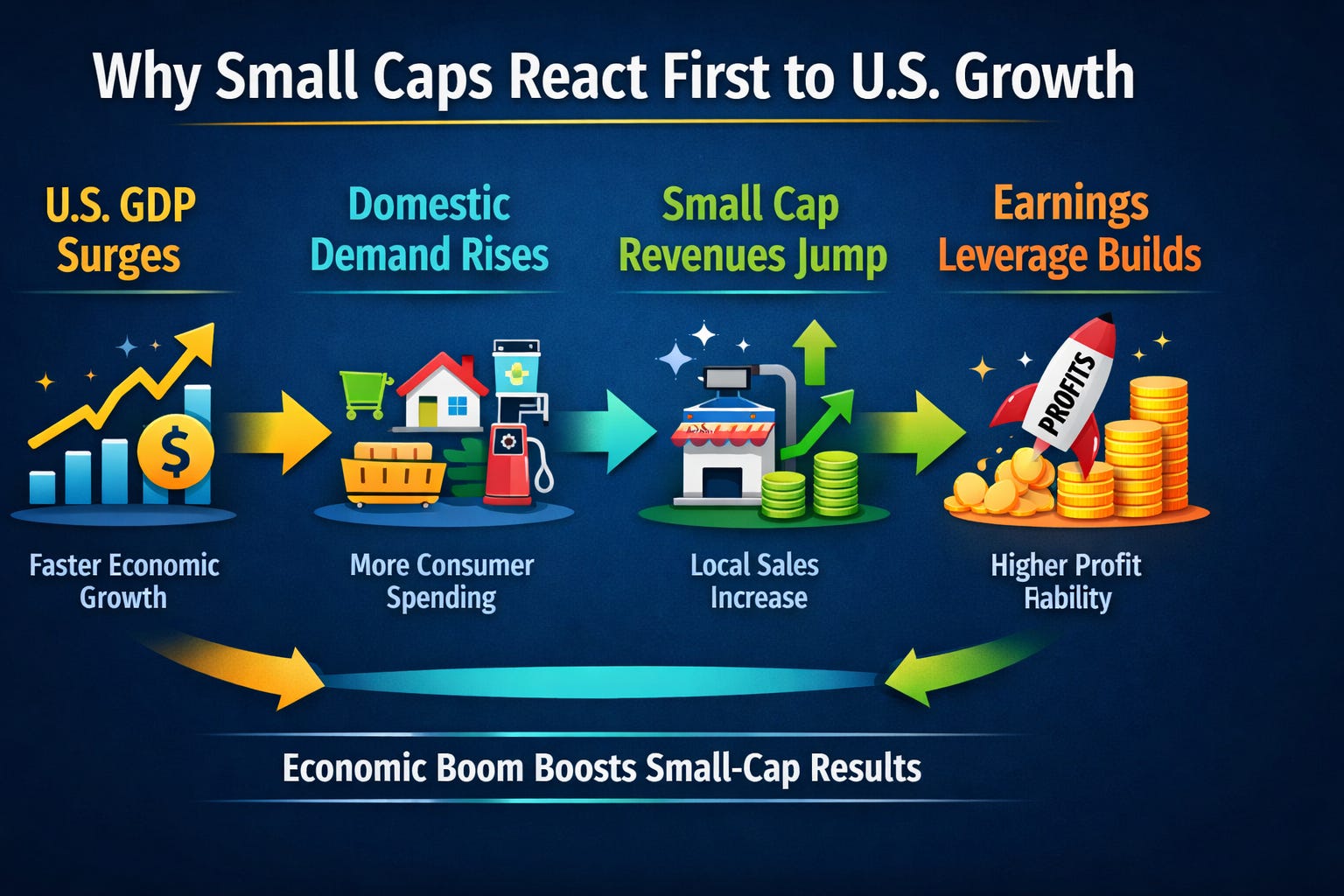
The strength in small caps has coincided with a notable improvement in domestic economic data. U.S. growth expectations rose sharply toward the end of 2025, with real-time indicators pointing to a reacceleration in activity. At the same time, the labor market remained historically tight, reinforcing confidence in consumer demand. For smaller companies, which generate most of their revenues domestically, this environment is particularly supportive. When U.S. growth surprises to the upside, small caps tend to respond more directly than multinational large-cap firms.³⁴
Investor behavior has also played a central role. After an extended period in which a narrow group of mega-cap stocks dominated returns, capital has begun rotating into cheaper and more cyclical areas of the market. Small caps entered this phase trading at one of the deepest valuation discounts to large caps seen in decades. Once sentiment shifted, those compressed valuations amplified the upside. The Russell 2000’s extended streak of outperformance versus the S&P 500 reflected a broader improvement in market breadth rather than isolated gains in a handful of stocks.²⁵
Earnings expectations have added further support. After lagging for much of the previous year, profit growth among smaller companies began to stabilize and improve. Market participants increasingly view this earnings inflection as a key difference between the current rally and prior false starts.⁶
Risks Beneath the Surface
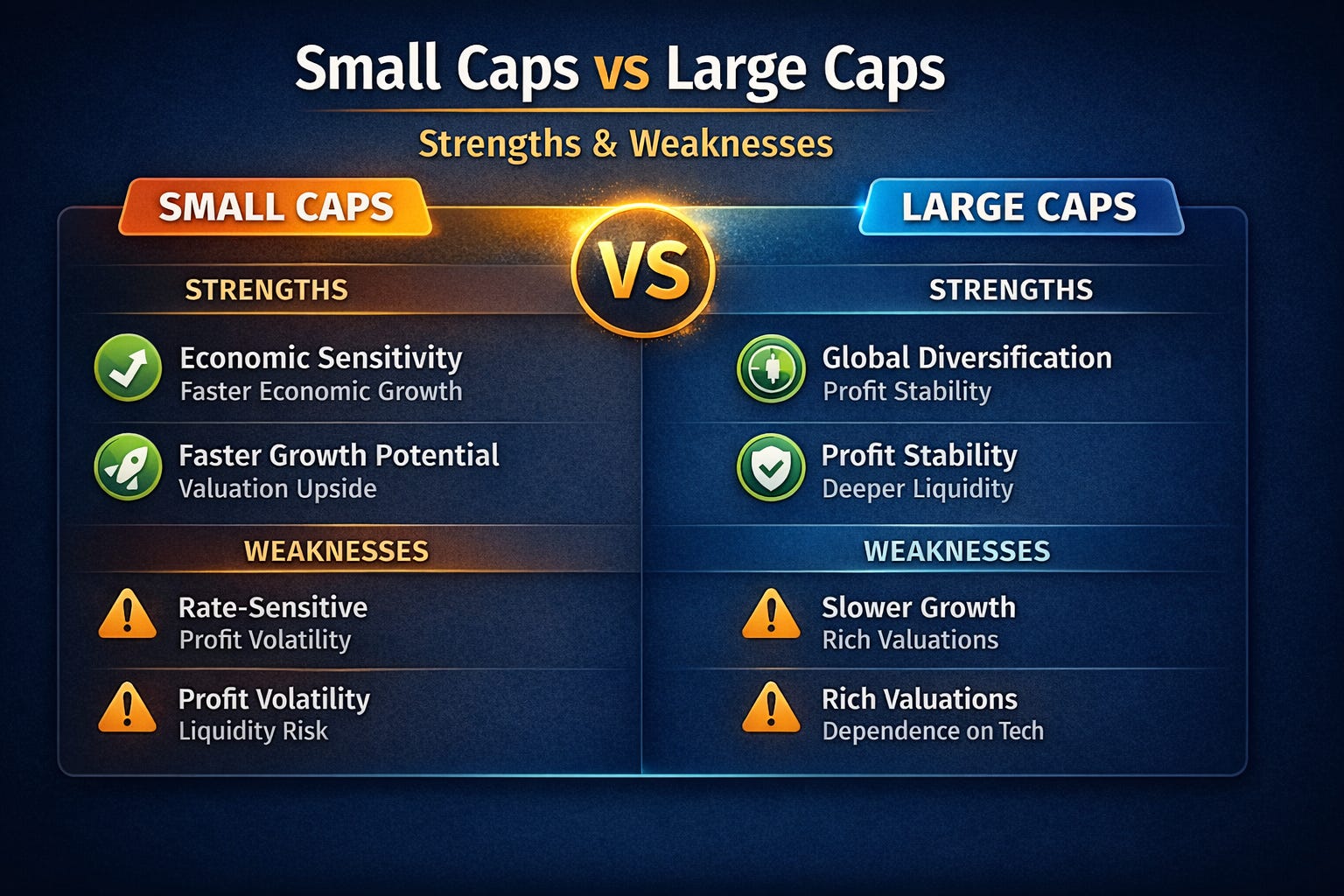
Despite the constructive backdrop, risks remain. A significant portion of the rally has been driven by lower-quality and unprofitable companies, a pattern often associated with speculative phases. Smaller firms also tend to carry higher debt burdens, making them especially sensitive to interest-rate volatility. If inflation pressures re-emerge or bond yields rise meaningfully, financing conditions could tighten quickly.⁷⁸
The sustainability of the rally will ultimately depend on earnings follow-through. Continued improvement in profits would reinforce the case for durable leadership, while disappointments could quickly undermine confidence. Credit availability, borrowing costs, and market breadth will be critical indicators to monitor in the months ahead.⁹
Durable Upswing or Temporary Surge?
So far, the evidence suggests the small-cap rally rests on firmer ground than many past rebounds. Strength has arrived alongside improving economic data, broader participation, and a recovering earnings outlook. Institutional sentiment has begun to shift as well, with several major firms upgrading small caps on expectations of a more favorable policy and growth environment.¹⁰
That said, volatility is inherent in this segment of the market, and pullbacks should be expected after such a rapid advance. Still, for the first time in years, small-cap stocks appear supported by both macro conditions and fundamentals rather than enthusiasm alone. If growth remains resilient and earnings continue to improve, this rally may prove more durable than skeptics expect.
Footnotes
Smallcap Network, “Markets Rebound Sharply as Tech and Small Caps Lead Broad Rally Across North America,” January 15, 2026.
Bloomberg News, “Stocks Get AI Boost as Small Caps Keep Rallying: Markets Wrap,” January 15, 2026.
Federal Reserve Bank of Atlanta, GDPNow Estimate for Fourth Quarter 2025, updated January 14, 2026.
Lucia Mutikani, “Weekly U.S. Jobless Claims Fall Unexpectedly, but Labor Market Treading Water,” Reuters, January 15, 2026.
Benjamin Wang and Zoey Zhu, “Finding Attractive Entry Points Into Small-Cap and Quality Stocks,” Janus Henderson Investors, January 16, 2026.
Niket Nishant et al., “Investors May Go Value Hunting in 2026 as AI Rally Matures,” Reuters, January 5, 2026.
Dow Jones MarketWatch, “Why the Record Rally for Small-Cap Stocks Could Run Into a Big Problem in 2026,” December 9, 2025.
Francis Gannon, interview with Isabel Wang, “Record Rally for Small Caps,” MarketWatch, December 9, 2025.
Royce Investment Partners, “Small-Cap Earnings and Market Breadth Commentary,” December 2025.
Mike Wilson, “2026 U.S. Equity Outlook: An Out-of-Consensus Growth View,” Morgan Stanley Research, November 19, 2025.
About Us
Jay D. Hatfield is CEO of Infrastructure Capital Advisors and is the lead portfolio manager of the Infrastructure Capital Bond Income ETF (NYSE: BNDS), InfraCap Small Cap Income ETF (NYSE: SCAP), InfraCap Equity Income Fund ETF (NYSE: ICAP), InfraCap MLP ETF (NYSE: AMZA), Virtus InfraCap U.S. Preferred Stock ETF (NYSE: PFFA), InfraCap REIT Preferred ETF (NYSE: PFFR) and private funds. Each month Infrastructure Capital hosts a monthly economic webinar; you can sign up to attend by visiting our website www.infracapfunds.com (important disclosures can also be found on the website). For a prospectus please reach out to us or visit the links above for each respective fund.
DISCLOSURE
This information is not an offer to sell, or solicitation of an offer to buy any investment product, security, or services offered by Jay Hatfield, or Infrastructure Capital Advisors, LLC, (“ICA”) or its affiliates. ICA, will only conduct such solicitation of an offer to buy any investment product or service offered by ICA, if at all, by (1) purported definitive documentation (which will include disclosures relating to investment objective, policies, risk factors, fees, tax implications and relevant qualifications), (2) to qualified participants, if applicable, and (3) only in those jurisdictions where permitted by law. Jay Hatfield or ICA may have a beneficial long or short position in securities discussed either through stock ownership, options, or other derivatives; nonetheless, under no circumstances does any article or interview represent a recommendation to buy or sell these securities. This discussion is intended to provide insight into stocks and the market for entertainment and information purposes only and is not a solicitation of any kind. ICA buys and sells securities on behalf of its fund investors and may do so, before and after any particular article herein is published, with respect to the securities discussed in any article posted. ICA’s appraisal of a company (price target) is only one factor that affects its decision whether to buy or sell shares in that company. Other factors might include, but are not limited to, the presence of mandatory limits on individual positions, decisions regarding portfolio exposures, and general market conditions and liquidity needs. As such, there may not always be consistency between the views expressed here and ICA’s trading or holdings on behalf of its fund investors. There may be conflicts between the content posted or discussed and the interests of ICA. Please reach out to the ICA for more information. Investors should make their own decisions regarding any investments mentioned, and their prospects based on such investors’ own review of publicly available information and should not rely on the information contained herein. ICA nor any of its affiliates accepts any liability whatsoever for any direct or consequential loss howsoever arising, directly or indirectly, from any use of the information contained herein. We have not sought, nor have we received, permission from any third-party to include their information in this article. Certain information contained in this document constitutes “forward-looking statements,” which can be identified by the use of forward-looking terminology such as “may,” “will,” “should,” “expect,” “anticipate,” “project,” “estimate,” “intend,” “continue” or “believe” or the negatives thereof or other variations thereon or other comparable terminology. Due to various risks and uncertainties, actual events or results may differ materially from those reflected or contemplated in such forward-looking statements.
The information contained herein represents our subjective belief and opinions and should not be construed as investment, tax, legal, or financial advice. Investors should consider the investment objectives, risks, charges, and expenses carefully before investing. Please read the prospectus carefully before investing. For more information about the Fund, Fund strategies or Infrastructure Capital, please reach out to Craig Starr at 212-763-8336 (Craig.Starr@icmllc.com). The Funds are distributed either by Quasar Distributors, LLC or by VP Distributors, LLC, an affiliate of Virtus ETF Advisers, LLC. ICAP, SCAP, and BNDS ETFs are distributed by Quasar Distributors LLC. PFFA, PFFR, and AMZA ETFs are distributed by VP Distributors, LLC an affiliated of Virtus ETF Advisers, LLC.