

FERC's Data Center Order Recalibrates the Utility and Infrastructure Income Playbook
The Federal Energy Regulatory Commission's June 2026 justify-or-reform order forces six grid operators to fast-track large-load interconnections as US utility capex tracks toward 1.3 trillion dollars.

The Federal Energy Regulatory Commission issued a justify-or-reform order in June 2026 directing six regional transmission organizations and independent system operators, PJM, MISO, ERCOT, CAISO, SPP, and NYISO, to either justify existing interconnection timelines or reform their processes to fast-track large loads of 20 megawatts or more.(1) The order responds directly to a surge in interconnection requests tied to data center and artificial intelligence infrastructure buildout, which has strained queues that were originally designed around a much slower pace of large-load additions.
Legal analysis of the order noted that it applies uniformly across grid operators covering the large majority of the US population, effectively setting a national floor for how quickly large electricity consumers can expect to connect to the grid going forward.(2) A single federal order reaching six separate grid operators simultaneously represents a coordinated regulatory response rather than a patchwork of regional fixes, a distinction that matters for utilities and infrastructure operators planning capital deployment across multiple service territories.
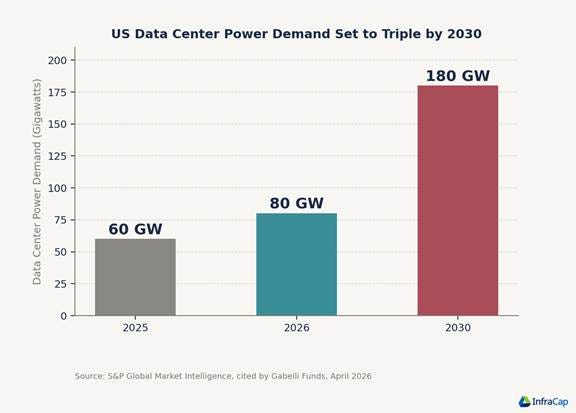
US Data Center Power Demand Set to Triple by 2030
The Capital Spending Wave Behind the Order
US utility capital expenditure is tracking toward approximately 1.3 trillion dollars through 2030, according to an April 2026 forecast from S&P Global Market Intelligence.(3) That figure reflects a sector-wide response to load growth that utilities had not planned for as recently as several years ago, when flat demand growth was the base case for long-term system planning across most of the country.
The scale of the demand shift explains why utilities are spending at this pace. US data center power demand is projected to grow from roughly 60 gigawatts in 2025 to 80 gigawatts in 2026, and then to approximately 180 gigawatts by 2030, according to S&P Global Market Intelligence data cited in Gabelli Funds research published in April 2026.(4) A tripling of data center power demand within five years requires transmission, generation, and distribution investment on a timeline that utilities are only now beginning to fully underwrite into their capital plans.
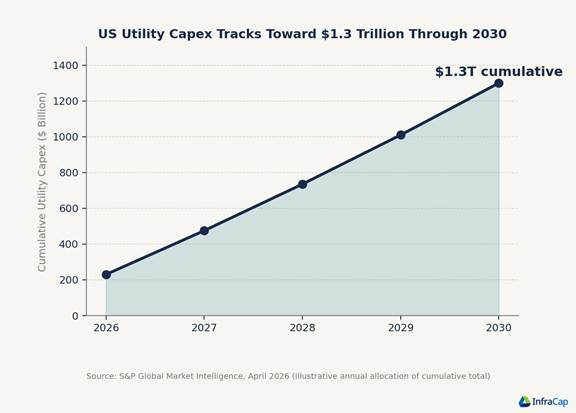
US Utility Capex Tracks Toward $1.3 Trillion Through 2030
Giga-Scale Projects Concentrate the Near-Term Load
Sixteen giga-scale data center projects, representing approximately 30 gigawatts of incremental load, are expected to come online between 2026 and 2027 alone, according to GridStrategies research.(5) That concentration of large, discrete projects arriving within a two-year window is precisely the kind of large-load interconnection volume that prompted FERC’s order, since a queue built for smaller, more gradual additions struggles to process a wave of 20-plus megawatt requests arriving in clusters.
Energy infrastructure operators outside the data center supply chain are also benefiting from the broader capital spending cycle. Enbridge raised its dividend by 3 percent in July 2026, pushing its yield above 5 percent, a move that reflects continued cash flow growth across pipeline and utility-adjacent energy infrastructure even as the data center buildout dominates capital spending headlines.(6)
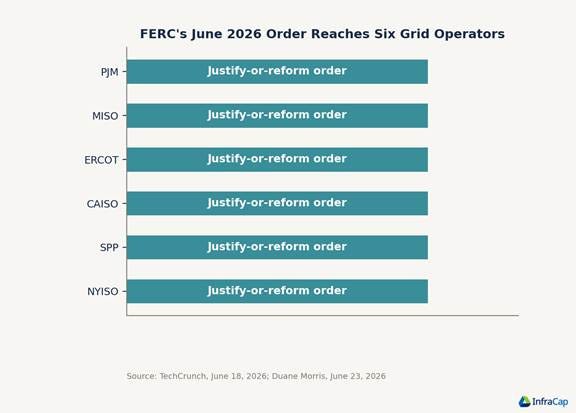
FERC’s June 2026 Order Reaches Six Grid Operators
Positioning Income Portfolios for a Multi-Year Buildout
The FERC order and the underlying demand data together describe a multi-year capital cycle rather than a short-term spending spike. A 1.3 trillion dollar utility capex forecast spread across the next several years, combined with a data center power footprint set to triple by 2030, suggests utilities, grid infrastructure operators, and adjacent energy companies face a sustained investment period that will shape earnings and dividend growth well past the current fiscal year.
Income-focused investors have increasingly looked to diversified infrastructure equity income exposure that spans utilities, energy infrastructure, financials tied to project lending, and real estate serving the same physical buildout, rather than concentrating in a single subsector, given how interconnected the data center power story has become across industries. Enbridge’s dividend increase and the pace of giga-scale project completions both point to cash flow growth continuing across multiple corners of the infrastructure income universe as FERC’s interconnection reforms work their way through six major grid regions over the coming years.
1. TechCrunch, coverage of FERC justify-or-reform order, June 18, 2026.
2. Duane Morris, legal alert on FERC large-load interconnection order across six RTO regions, June 23, 2026.
3. S&P Global Market Intelligence, US utility capital expenditure forecast, April 2026.
4. S&P Global Market Intelligence data, cited in Gabelli Funds research, April 2026.
5. GridStrategies, giga-scale data center project research, 2026.
6. AlphaBetaStock, Enbridge dividend increase coverage, July 2026.
About Us
Infrastructure Capital Advisors LLC is a SEC-registered investment adviser based in New York. The firm offers an ETF suite covering bond income, small-cap income, equity income, MLPs, preferred stock, and REIT preferreds. Funds: BNDS (Infrastructure Capital Bond Income ETF); SCAP (InfraCap Small Cap Income ETF); ICAP (InfraCap Equity Income Fund ETF); AMZA (InfraCap MLP ETF); PFFA (Virtus InfraCap U.S. Preferred Stock ETF); PFFR (InfraCap REIT Preferred ETF). For more information visit www.infracapfunds.com.
DISCLOSURE
This information is not an offer to sell, or solicitation of an offer to buy any investment product, security, or services offered by Jay Hatfield, or Infrastructure Capital Advisors, LLC, (”ICA”) or its affiliates. ICA, will only conduct such solicitation of an offer to buy any investment product or service offered by ICA, if at all, by (1) purported definitive documentation (which will include disclosures relating to investment objective, policies, risk factors, fees, tax implications and relevant qualifications), (2) to qualified participants, if applicable, and (3) only in those jurisdictions where permitted by law. Jay Hatfield or ICA may have a beneficial long or short position in securities discussed either through stock ownership, options, or other derivatives; nonetheless, under no circumstances does any article or interview represent a recommendation to buy or sell these securities. This discussion is intended to provide insight into stocks and the market for entertainment and information purposes only and is not a solicitation of any kind. ICA buys and sells securities on behalf of its fund investors and may do so, before and after any particular article herein is published, with respect to the securities discussed in any article posted. ICA’s appraisal of a company (price target) is only one factor that affects its decision whether to buy or sell shares in that company. Other factors might include, but are not limited to, the presence of mandatory limits on individual positions, decisions regarding portfolio exposures, and general market conditions and liquidity needs. As such, there may not always be consistency between the views expressed here and ICA’s trading or holdings on behalf of its fund investors. There may be conflicts between the content posted or discussed and the interests of ICA. Please reach out to the ICA for more information. Investors should make their own decisions regarding any investments mentioned, and their prospects based on such investors’ own review of publicly available information and should not rely on the information contained herein. ICA nor any of its affiliates accepts any liability whatsoever for any direct or consequential loss howsoever arising, directly or indirectly, from any use of the information contained herein. We have not sought, nor have we received, permission from any third-party to include their information in this article. Certain information contained in this document constitutes “forward-looking statements,” which can be identified by the use of forward-looking terminology such as “may,” “will,” “should,” “expect,” “anticipate,” “project,” “estimate,” “intend,” “continue” or “believe” or the negatives thereof or other variations thereon or other comparable terminology. Due to various risks and uncertainties, actual events or results may differ materially from those reflected or contemplated in such forward-looking statements.
This material must be preceded or accompanied by a prospectus. The information contained herein represents our subjective belief and opinions and should not be construed as investment, tax, legal, or financial advice. For a prospectus with this and other information about the Funds, please visit www.infracapfunds.com. Investors should consider the investment objectives, risks, charges, and expenses carefully before investing. Please read the prospectus carefully before investing. For more information about the Funds, Fund strategies or Infrastructure Capital, please reach out to Craig Starr at 212-763-8336 (Craig.Starr@icmllc.com). The Funds are distributed either by Quasar Distributors, LLC or by VP Distributors, LLC, an affiliate of Virtus ETF Advisers, LLC. ICAP, SCAP, and BNDS ETFs are distributed by Quasar Distributors LLC. PFFA, PFFR, and AMZA ETFs are distributed by VP Distributors, LLC an affiliated of Virtus ETF Advisers, LLC.